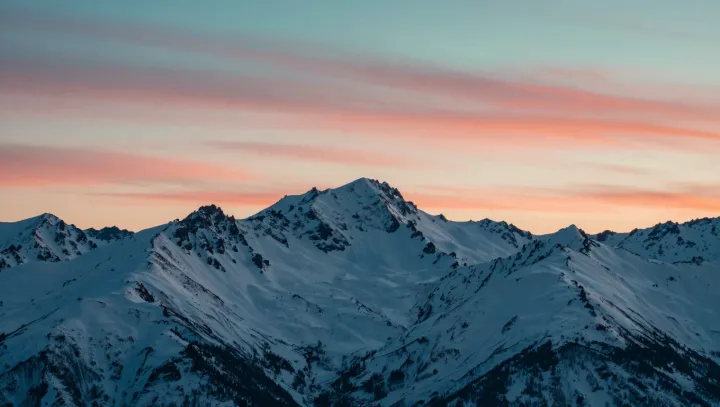
A snow-covered summit can look like it is on fire while remaining well below freezing. The glow comes from geometry and optics, not from temperature. As the Sun approaches the horizon, its light travels through a longer path in the atmosphere. Shorter wavelengths are removed by Rayleigh scattering, so the remaining direct sunlight is rich in reds and oranges when it reaches high peaks.
Snow then acts as a highly efficient reflector. Its crystalline ice grains create multiple internal reflections and refractions, a process related to radiative transfer, which mixes and diffuses the incoming red light across the surface. Because snow has a high albedo, it bounces much of this colored light back toward distant observers, enhancing the apparent saturation of the warm hues without adding measurable heat to the snowpack.
The effect is often strongest on peaks that remain in direct sunlight while valleys have already slipped into shadow. This contrast sharpens the illusion that the mountain is glowing from within. Thermodynamic variables such as surface temperature and heat flux remain dominated by the cold air and longwave infrared emission, even as the visible spectrum briefly paints the peak in colors associated with warmth.