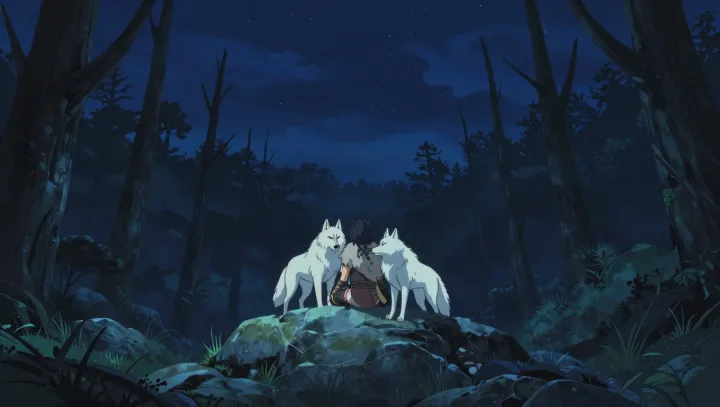
A forest god pierced by iron becomes the most lucid briefing on ecology that popular cinema has offered. Princess Mononoke stages a conflict where no side is wholly wrong: a mining settlement seeks survival and security, while an ancient ecosystem responds to disrupted energy and resource flows. The film’s hand‑drawn wolves, boars and gods operate like visible models of trophic levels, nutrient cycles and feedback loops rather than ornamental fantasy.
Ecological carrying capacity and entropy are quietly embedded in the plot. Every blast furnace, rifle shot and felled tree raises the system’s disorder, pushing forests, rivers and human bodies past their thresholds for regeneration. Industrial technology is not demonized; it improves health, productivity and social mobility. Yet each gain carries a marginal cost to biodiversity and watershed stability, showing a kind of environmental marginal utility curve in motion. Ashitaka’s journey is less a moral sermon than a moving risk‑benefit analysis, asking how far extraction and infrastructure can scale before complex systems collapse.
The choice of hand‑drawn animation is crucial to this argument. By exaggerating textures of fur, soil and smoke, the film makes energy transfer, pollution and symbiosis legible at a glance, turning abstract mechanisms like bioaccumulation and habitat fragmentation into concrete, kinetic images. Fantasy here is not an escape from science but a precision tool for visualizing ecological systems that are otherwise too vast, slow or entangled to see at once, leaving the viewer suspended between awe at human ingenuity and unease at its accumulating biological debt.