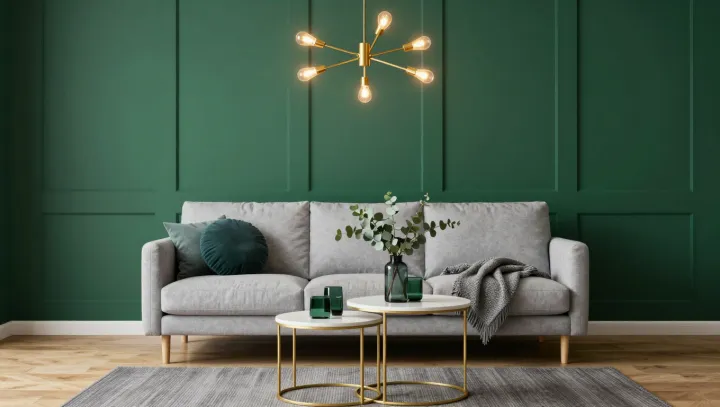
A blank wall can act like a zoom lens. Shift its color, and the room seems to stretch or compress, even though the floor plan has not changed by a millimeter. The effect starts with luminance, the physical measure of light reflected from a surface, which the visual cortex treats as a shortcut for distance and scale.
Light, low‑saturation walls push themselves into the background. Your brain, wired for atmospheric perspective, reads bright, low‑contrast planes as farther away, a trick borrowed from outdoor haze. Dark, high‑contrast walls do the reverse, increasing edge detection and making boundaries feel closer, so the same sofa suddenly appears wedged into a tighter envelope of space.
The bolder claim is that color can quietly edit floor area in your mind. It does so by hacking peripheral vision and figure‑ground segmentation: when walls, ceiling, and trim sit in a narrow band of hue and value, the eye stops registering hard breaks, so the container of the room dissolves and objects float. Sharper color shifts and darker ceilings crank up perceived enclosure, shrinking the mental blueprint without moving a chair.