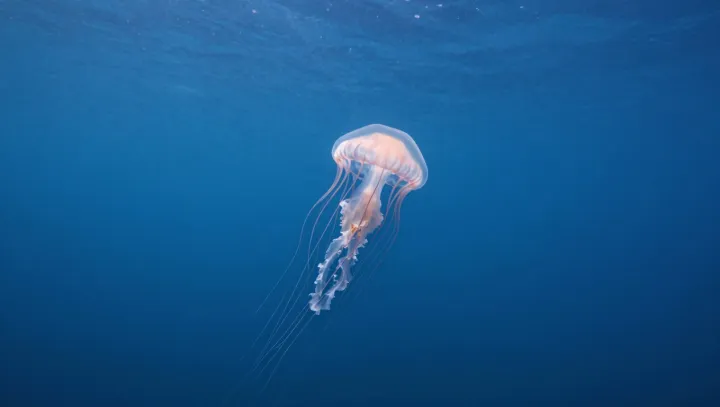
No solid skeleton, no central brain, yet efficient predation. In the open sea, a jellyfish hangs like a translucent parachute, its bell pulsing, its tentacles trailing a curtain of stinging cells. This body is about ninety five percent water, supported by mesoglea, a gelatinous matrix that holds scattered muscle fibers and a diffuse nerve net instead of a spinal column and cortex.
The real surprise is that such a loose design still runs complex behavior. Brief nerve impulses race through that nerve net, coordinating bell contractions that generate jet propulsion and steering responses to currents, light and chemicals. Cnidocytes, the microscopic harpoon cells lining the tentacles, fire on contact with prey, injecting toxins in a fraction of a second, so the animal can hunt without conscious targeting or articulated limbs.
Even the eerie glow is not decorative excess. Within specialized cells, bioluminescent proteins such as luciferase and luciferin convert chemical energy into cold light, triggered by ionic flux across cell membranes. Short flashes can lure crustaceans, startle predators, or act as a burglar alarm that exposes an attacker to something larger. In that sparse network of tissue and ions, a kind of minimal intelligence emerges, just enough for a drifting ghost to feed, signal and endure in the dark water column.