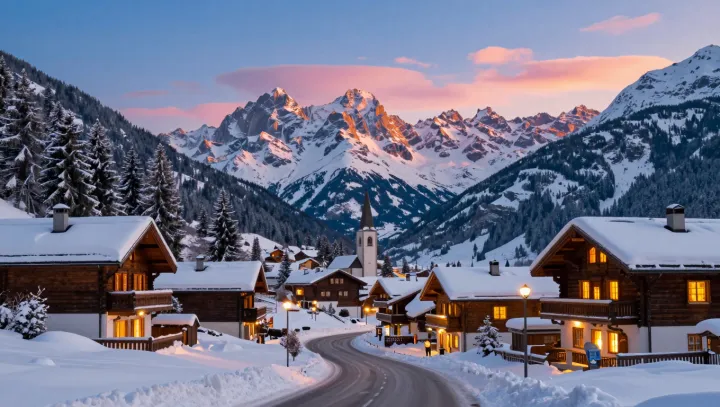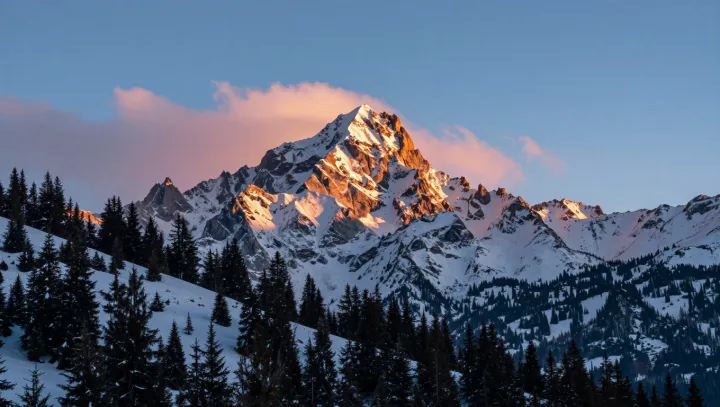
Snow does something counterintuitive to sunsets. It makes cold evenings look optically warmer, even when air temperature drops and the forest below sits in shadow. High ridges coated in bright snow present a strong albedo surface, and that reflective sheet intercepts sunlight in a zone where the path through the atmosphere is already rich in long wavelengths after Rayleigh scattering has stripped much of the blue.
The key effect is simple. Yet the geometry is not. As the sun sinks, its rays skim low through the troposphere, where selective scattering and aerosol extinction favor reds and oranges; snowfields on peaks sit directly in that beam, turning into giant secondary emitters that bounce this filtered light sideways and downward. Instead of light dying at the horizon, it is re-launched from thousands of tiny ice crystals, each grain acting as a micro-mirror with a high refractive index contrast to air, enhancing both diffuse reflection and backscatter toward the valley.
The forest does not stand a chance. Dark needles and trunks absorb most of the same radiation, so they contribute almost no return glow; against that muted foreground, the illuminated snow and the sky above it appear even more saturated. Add in multiple scattering between airborne ice crystals, known as diamond dust, and the bright snowpack, and the system behaves like a coupled cavity for red light. What looks like a sentimental sunset is in fact a hard-edged exercise in radiative transfer and surface optics.