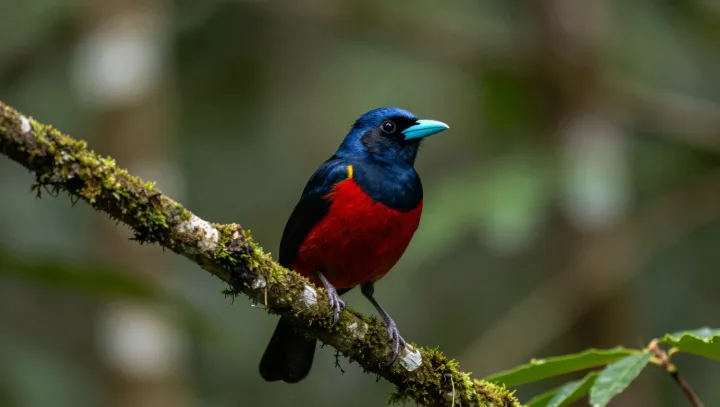
Color here is not decoration; it is strategy. The black-and-red broadbill carries plumage so high contrast that it looks almost reckless, yet its body plan and behavior read like a risk-management manual shaped by selection pressure.
Most striking is this paradox: the bird is both visible and hidden at once. Its crimson breast and turquoise bill act as an aposematic-style flag in social contexts, broadcasting species identity and pairing status, while the deep black mantle absorbs light in dense riverine shade, exploiting low luminance and background clutter to erase its outline at distance. Predators with limited color discrimination at low light levels respond mainly to brightness, not hue, so the sharp chromatic contrast that dazzles in a field guide collapses into muted patches from a raptor’s vantage point.
Equally calculated is where that color sits. High-saturation areas cluster on the ventral side and head, which the bird can partially veil by posture, feather compression, and branch choice, a form of behavioral crypsis layered on top of structural coloration. When perched crosswise over dark water, the black upperparts align with shadowed branches, while red zones break into fragmented tokens that mimic sun flecks and leaf gaps, exploiting principles of disruptive coloration and counter-shading. During display flights or pair contact, the bird intentionally exposes the full palette at close range, effectively leveraging its own visibility as a controlled asset rather than a constant liability.