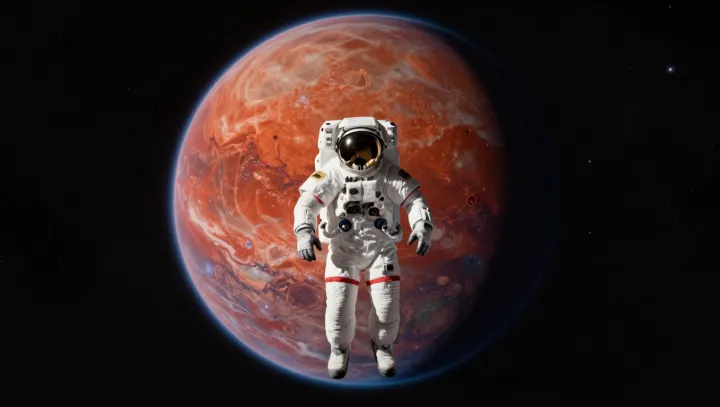
Weight has not vanished; it is in disguise. Inside an orbiting station, astronauts float while gravity still pulls with almost the same acceleration that objects feel at the surface, a fact confirmed by Newtonian gravitation and precise orbital mechanics calculations.
The key claim is harshly simple. They are falling. The station and every loose object inside share the same continuous free fall, following a curved trajectory where centripetal acceleration from orbital motion matches gravitational pull toward Earth, so no support force presses on their bodies and the sensation of weight disappears.
What looks like an absence of gravity is instead an absence of normal force. Scales measure that contact force, not the gravitational field itself, so in orbit a scale pushed by an astronaut would read near zero while the local gravitational acceleration remains only slightly weaker than at ground level, a textbook case of inertial frame physics.
This free-fall environment is called microgravity for a reason. Tiny residual forces still exist, from atmospheric drag, spacecraft vibrations, and gravity gradients, but they are small enough that a released droplet or tool drifts gently beside an astronaut, turning a strong gravitational field into a laboratory that feels almost empty.