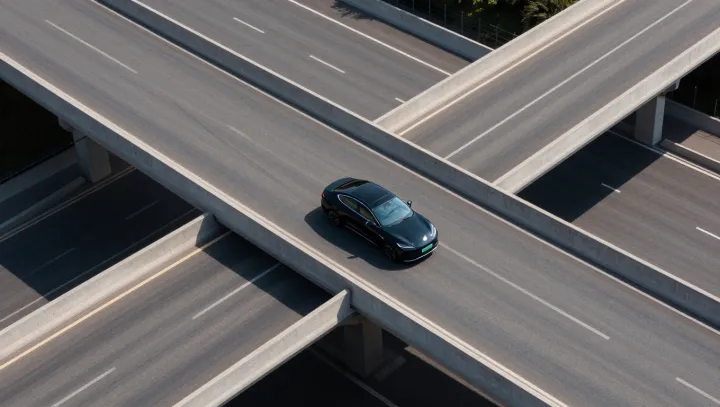
Chaos on a cloverleaf misleads most minds. The calm driver treats it as a geometry problem, not a social one, reading lane lines like rails that will not lie, while the cars remain secondary, noisy variables in a much cleaner equation.
That bias toward paint over metal is not mystical composure; it is applied neurophysiology. Human vision and the dorsal attention network are built to track stable contours and vanishing points, so early fixation on lane markings feeds the brain a predictable optic flow field and lets the frontal cortex run predictive processing instead of crisis triage on every weaving bumper nearby.
Equally counterintuitive is the single, gentle steering move. Frequent micro-corrections feel attentive yet flood the cerebellum and motor cortex with error signals, forcing constant proprioceptive recalibration and enlarging the zone for oversteer. One decisive trajectory change, planned a few seconds upstream from the merge, reduces control-loop noise, lowers lateral acceleration spikes and keeps tire grip, vestibular cues and reaction time aligned instead of at war.