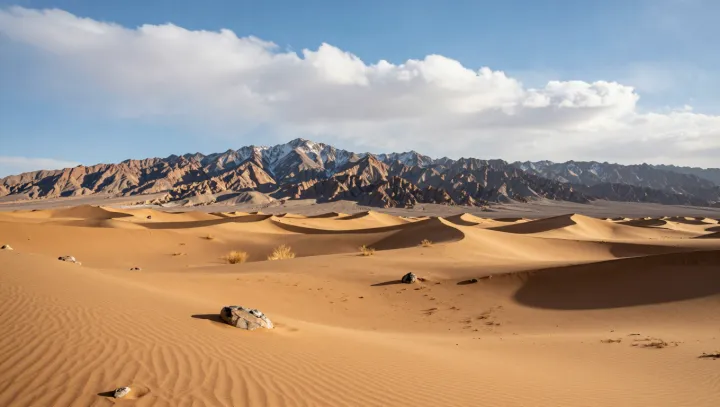
Stillness here is a lie. Under a hard blue sky, ridges of sand throw clean shadows, edges sharp enough to suggest nothing has moved for an age, yet every grain is in negotiation with the air pressing over it.
This apparent stability hides one of the fastest surface engines on the planet, because wind shear stress and fluid dynamics rewrite the topography each gust. Individual grains lift in saltation, arc forward, then slam down, knocking others into motion in a chain reaction that geophysicists can model but never fully tame. On the windward face, grains crawl and hop upward by surface creep and impact, building a lip so thinly balanced that a few extra particles trigger a miniature avalanche down the slip face, resetting the profile while preserving the dune’s overall form.
The unsettling truth is that the body moves while the shape pretends to stay the same. A dune can advance several meters within a single storm cycle, its volume conserved yet its position displaced, like a slow conveyor belt driven only by pressure gradients in turbulent air. Satellite imagery and lidar surveys show crests shifting, horns stretching, fields of barchan and star dunes migrating, colliding, merging, eroding. What looks like a frozen monument is, grain by grain, walking out of the frame.