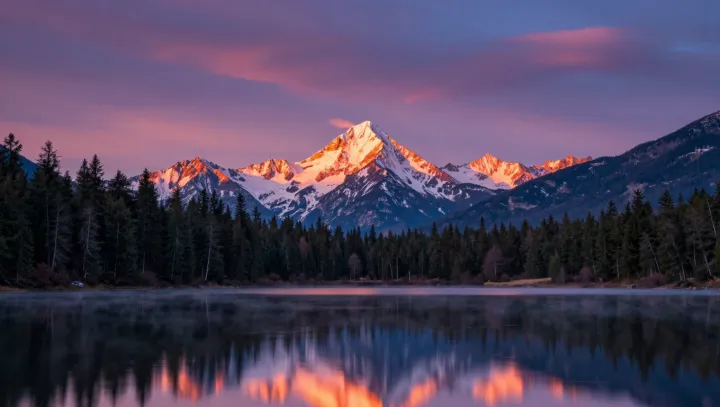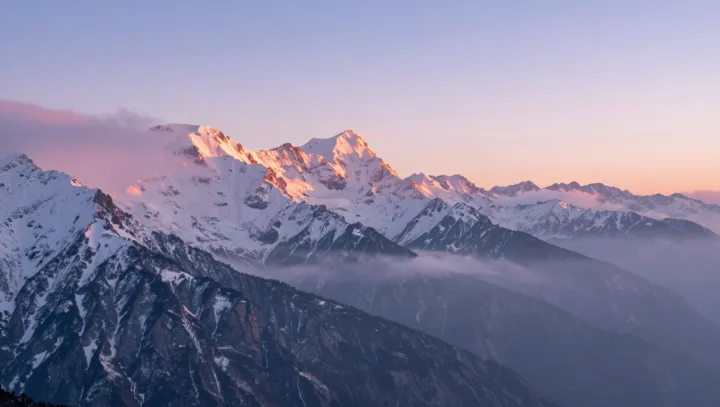
Those pink summits are not romantic at all; they are ruthless physics in plain sight. When the sun sits low, its rays cross a long path through the atmosphere, so shorter wavelengths are scattered out by Rayleigh scattering and aerosols before the beam ever reaches the mountains. What survives that journey is a spectrum biased toward longer wavelengths, the reds and oranges that strike high slopes already in direct line of sight while the sun is still hidden from the valley floor.
More surprising is how ice itself edits that light. On high ridges, snow grains and tiny ice crystals act as a dense field of prisms and mirrors, producing multiple internal reflections and a form of volumetric backscatter that throws warm colors toward an observer. That process, known as alpenglow, favors red because those photons have already slipped through the atmospheric filter, while much of the blue has been stripped away or diverted sideways before it can illuminate the peaks with the same intensity.
Down in the valley, the physics tilts toward gloom. Slopes block the direct beam, so air molecules, water droplets and dust dominate what you see, filling the shadow with skylight that is blue rich thanks to wavelength dependent scattering. The same dawn light field therefore splits into two different scenes: a high zone bathed in long path, red weighted radiation, and a low zone lit mainly by diffuse, blue scattered flux from the vault of sky.