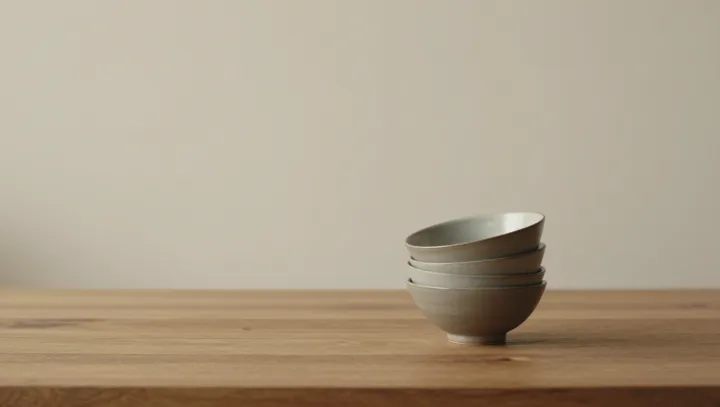
Soft light on stacked bowls can feel more settling than an immaculate room, and that is not an aesthetic accident. A small, neutral cluster keeps visual input low in contrast and complexity, which reduces what neuroscientists call sensory gating load, the brain’s effort to filter irrelevant stimuli before they flood higher cortical areas.
The counterintuitive point is this: a perfectly tidy room still screams for processing. Every corner, every surface, still offers dozens of edges, colors, and potential tasks, so visual cortex and dorsal attention networks stay partially on alert, scanning for anomalies that might signal work to be done. By contrast, a few tone-on-tone bowls create a micro field of predictable geometry, letting predictive coding circuits in the brain generate accurate, low-error guesses about what comes next, so there is almost nothing for error-monitoring pathways to correct.
Equally important is that this stack looks like a ritual in standby mode. Repetition and balance signal an action schema to motor planning regions and the basal ganglia, hinting at a simple routine that begins and ends cleanly. That cue taps into the brain’s reward circuitry, including dopaminergic pathways, not because the bowls are beautiful, but because they promise a small, controllable loop of behavior. In a world that rarely feels controllable at scale, those quiet, balanced objects become a visual anchor for manageable action, and the mind rests against them like a hand on a rail.