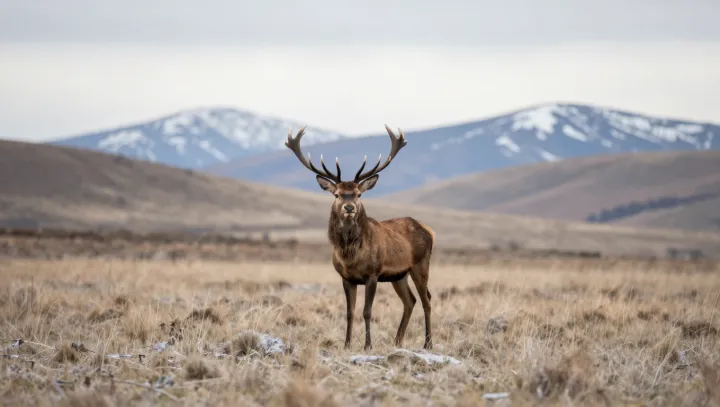
Bare bone and tendon, a stag’s lower leg looks poorly designed for ice. The judgment is wrong. Hidden in that skinny column is a sophisticated thermal circuit that keeps tissue alive while wasting as little heat as possible.
Key to the trick is countercurrent heat exchange. Arteries carrying hot blood from the core run tightly alongside veins returning cold blood from the hoof, so heat diffuses from outgoing to incoming flow and the hoof never receives full body temperature. This vascular loop sharply reduces heat loss into frozen ground, yet still supplies enough warmth and oxygen for muscle fibers and peripheral nerves to keep firing without frost damage.
Equally important is what the leg lacks. Little insulating fat means very low thermal inertia, so the stag can let distal tissues cool almost to ambient without risking the deep core. Dense collagen in tendons tolerates that chill better than metabolically active organs, while keratin in the hoof acts as a hard, dry interface that limits conductive heat transfer into ice or snow.
The system is not passive. Through vasoconstriction and vasodilation under autonomic nervous control, blood flow to the extremity can be throttled down to conserve heat or briefly boosted to prevent local freezing. What looks like a vulnerable stick in the snow is, in engineering terms, a live, self‑tuning heat exchanger mounted on four hooves.