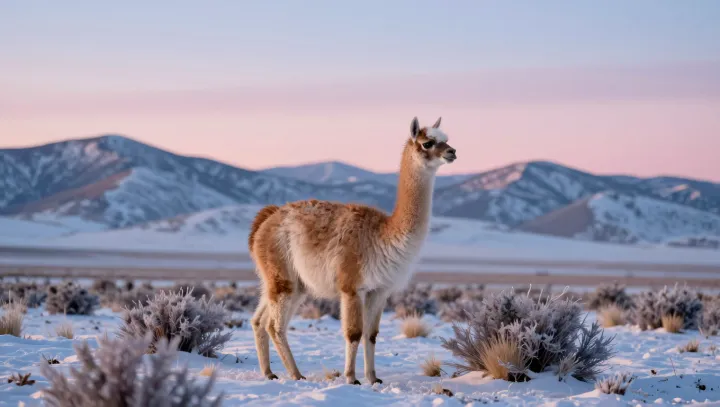
A coat this delicate should fail. Yet vicuña fleece, thinner than cashmere, keeps a mid‑sized grazer alive on bare Andean ridges where air bites and shelter hardly exists. Under a microscope, its fibers average less than fifteen micrometers in diameter, sliding past the typical cashmere range, which already sits well below human hair.
The secret is not softness; it is architecture. Each fiber carries a partially hollow core, a form of medullation that traps still air like micro‑double‑glazing while keeping mass low. Around it, a cuticle of fine scales interlocks just enough to reduce convective heat loss without forming the heavy felt that would load a fifty‑kilogram body with wasted weight and water. Short sentence. Fiber density on the skin surface is extreme, building a thick boundary layer of trapped air that acts as the true insulator rather than the keratin itself.
Even that would be wasted without biology that treats the coat as active gear. Vasoconstriction in peripheral vessels reduces heat loss from exposed limbs, forcing warm blood to circulate under the fleece where that aerogel‑like layer works best. Sebaceous secretions tune moisture and reduce evaporative cooling, so the animal can stand in abrasive, freezing wind while core temperature drifts only within a tight physiological band, proof that elegance can be a survival design rather than a luxury flourish.