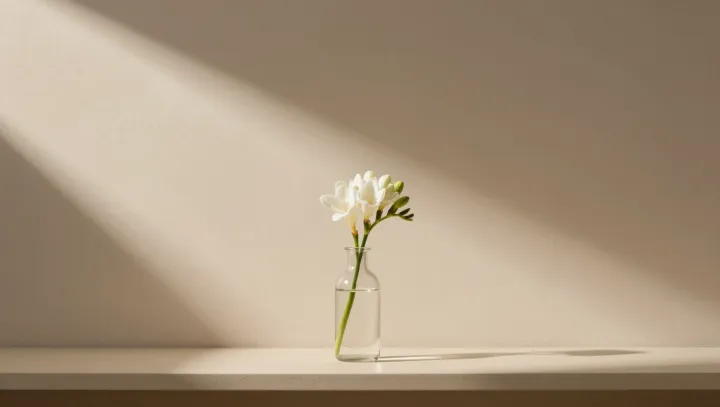
A bare glass bottle with a single white flower is not simple at all. Against that nearly empty field, the brain has no place to hide its choices, so every microsecond of visual attention becomes easier to read and measure for researchers. With one contour, one hue, one source of contrast, scientists can track how feature detectors in primary visual cortex lock on, how saccadic eye movements settle, and how competing signals are suppressed before they ever rise to awareness.
Crowded, colorful scenes feel more informative, yet they are experimental noise factories. Multiple objects trigger overlapping receptive fields, lateral inhibition, and attentional blink in ways that blur cause and effect, masking which item actually won the neural lottery. The solitary flower, by contrast, strips perception down to signal and baseline, allowing imaging tools to isolate changes in firing rate, to map top‑down attention from frontal networks, and to show how a single, stable target can still expose the limits of visual working memory.