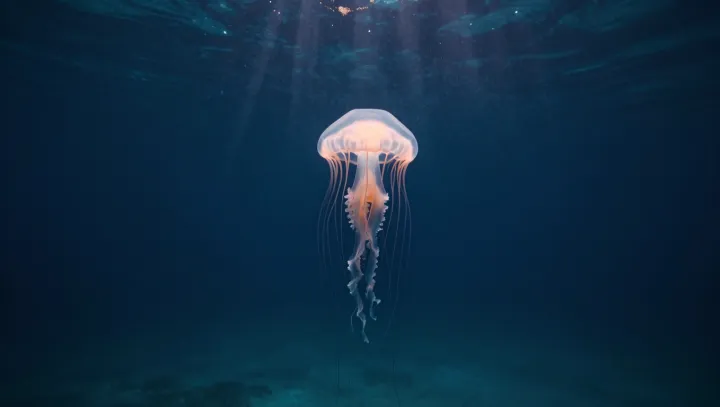
A jellyfish swims with more order than many animals that carry a brain. Its bell pulses in clean cycles, each contraction timed so the whole body acts as one moving unit in water. No central processor sits in the middle; the coordination comes from a mesh of local circuits and the stubborn predictability of physics.
The stark fact is that control is outsourced. Instead of a brain, jellyfish carry diffuse nerve nets and ring-like nerve cords that run around the bell, where sensory cells and motor neurons couple almost directly. Light, chemicals and stretch activate neurons in these nets, and the signal spreads as a wave, not as a command from a single hub, so muscle sheets fire in a spreading ring that tightens the bell in a near-perfect geometric pattern.
The more surprising edge is that water does half the work. Each contraction drives out a jet that forms a starting vortex, and when the bell relaxes its elastic tissue, a stopping vortex curls under the bell and helps pull water back, a hydrodynamic trick that recovers energy like a spring. Studies of locomotion mechanics show that if the bell size, tissue stiffness and contraction period sit in the right resonance window, the animal gains efficient thrust with almost no computation, because the fluid dynamics clean up timing errors.
The unsettling implication is that grace can be prewired into flesh. Where complex animals spend neural resources on gait control, jellyfish embed much of their swimming algorithm in collagen, muscle architecture and fluid inertia. The nerve net just kicks the system; the bell and the water handle the choreography.