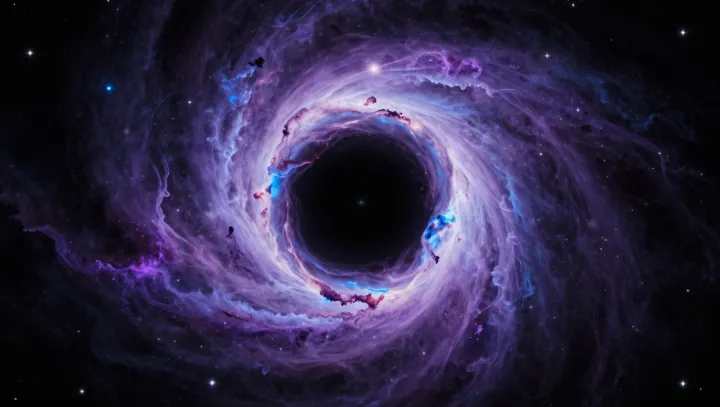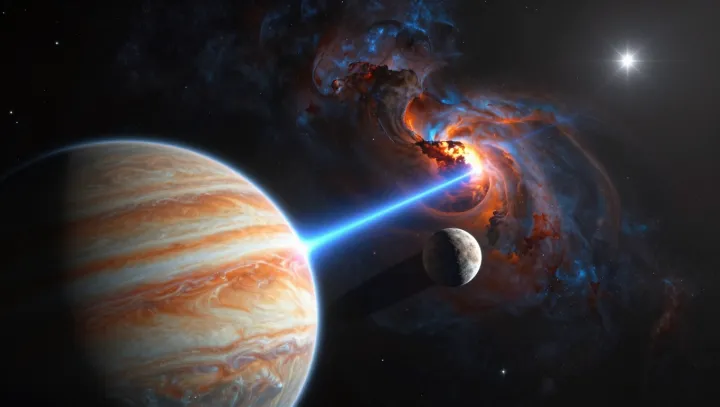
A single jet, narrower than a human hair when projected across its full length, can embarrass entire galaxies in raw brightness. Not because it holds more mass, but because a spinning black hole concentrates power into a beam of particles fired at near light speed.
The harsh claim from radio and X‑ray observatories is simple: geometry beats quantity. As material spirals into the event horizon, magnetic fields anchored in the accretion disk twist into helical structures, forcing plasma into a relativistic jet with extreme collimation. Instead of glowing in all directions like stars in a disk, that energy is funneled into a narrow solid angle. To an unlucky line of sight, the effect, called relativistic beaming, amplifies the apparent luminosity by orders of magnitude, making the jet look brighter than the galaxy that hosts it.
Even stranger is the sculpting. A jet that stays coherent across thousands of light‑years rams into a surrounding nebula and turns into a cosmic cutting torch. Shock fronts compress gas. Kelvin‑Helmholtz instabilities shred the flow into knots and filaments. Synchrotron radiation from electrons spiraling along magnetic field lines paints glowing arcs and cavities. What looks like delicate lace in telescope images is, in fact, a record of sustained, collimated violence from a compact object that itself remains invisible.