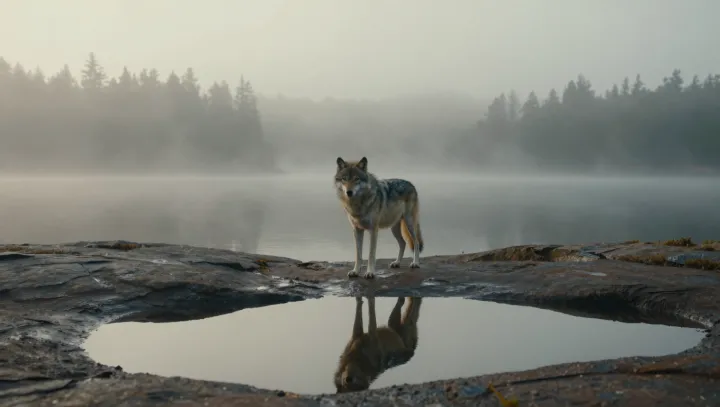
Dawn fog looks like a handicap for a sight hunter; in practice, it can be its greatest ally. When a pursuit specialist stands almost motionless at the water’s edge, the scattered light in the mist compresses visual range, forcing prey to rely on coarse motion cues instead of fine detail. Ethologists note that under low contrast, prey detection thresholds rise, buying the predator extra seconds in which a twitch would betray it under clear air.
Still water seems even more unlikely. Yet it offers two hidden advantages. First comes physics: a glassy surface acts as both mirror and early warning system, turning the predator’s own reflection into a calibration tool for micro‑movements while ripples advertise any approaching threat. Second comes optics: against a nearly perfect reflection of the sky, a motionless body aligned with its mirror image breaks familiar silhouettes, exploiting limitations in prey edge‑detection neurons and lateral inhibition circuits.
Speed, ironically, is the backup plan. The real survival trick is energy economics. By defaulting to sit‑and‑wait tactics in fog and over still water, the animal slashes metabolic cost, delaying the burst of anaerobic glycolysis until probability of a clean strike peaks. Biologists tracking kill rates report that a single explosive dash, launched from this near‑statue posture, outperforms multiple open‑chase attempts in both success ratio and injury avoidance.