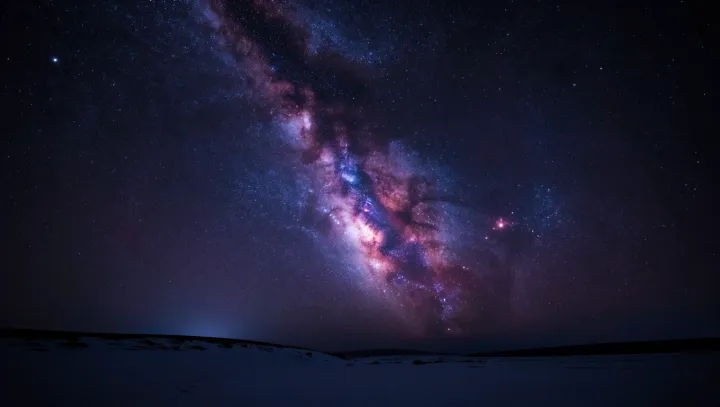
Darkness, not brightness, is the real optical illusion. Space is packed with radiation, yet human eyes register only a sparse spray of stars because most of that energy never shows up in the narrow band called visible light.
A first culprit is simple obstruction. Interstellar dust grains, only micrometers across, scatter and absorb starlight, especially blue wavelengths, so entire regions vanish behind cold foreground clouds while still blazing in infrared. Radiative transfer, not emptiness, edits the sky before it reaches any telescope or retina.
More decisive is that the universe itself stretches the light. As space expands, photons traveling across vast comoving distances lose energy through cosmological redshift, sliding from visible bands into infrared and radio. What began as bright ultraviolet from early stars now arrives as a faint hiss in detectors tuned far beyond human perception.
Most radical is the fact that the visible sky is unfinished. The observable universe is limited by the finite speed of light, so distant galaxies and gas clouds simply have not had time to send photons that can reach Earth. Beyond that horizon, activity proceeds unlit to us, not because it is dark, but because its light is still on the way.