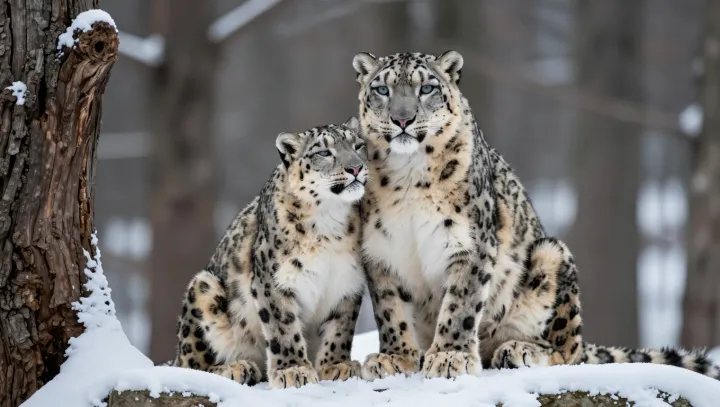
Ancestry guarantees no roar. Although snow leopards belong to Panthera, the genus that includes lions and tigers, their throats lack the same sound-producing specializations. The distinction exposes a weakness in the familiar label "big cat": membership describes evolutionary relationships, not a promise that every relative will deliver the same thunderous performance.
The familiar explanation misleads. Roaring was once attributed chiefly to the hyoid apparatus, a supporting structure associated with the tongue and throat, whose partly ligamentous construction allows greater movement than a fully bony arrangement. Snow leopards share that flexibility. Yet roaring also requires suitable vocal folds within the voice box: lions and tigers possess bulky folds with tissue properties and a broad, relatively square profile that support powerful, low-frequency vibration. Snow leopards lack equivalent specializations. Their anatomy therefore undercuts the tidy claim that one flexible throat structure separates roaring cats from all the rest.
Silence is the wrong verdict. Snow leopards produce growls, hisses, moans and friendly chuffing sounds, while their louder calls can help individuals communicate when separated across mountain slopes. Roaring is only one option. Nor does the missing roar make their classification a mistake, because genetic evidence places them within Panthera and identifies tigers as their closest living relatives. Kinship survives the acoustic difference. The lesson is less about an animal falling short than about evolution preserving family resemblance while allowing particular structures to diverge; on a bare slope, a snow leopard opens its mouth, and the family resemblance ends at the sound.