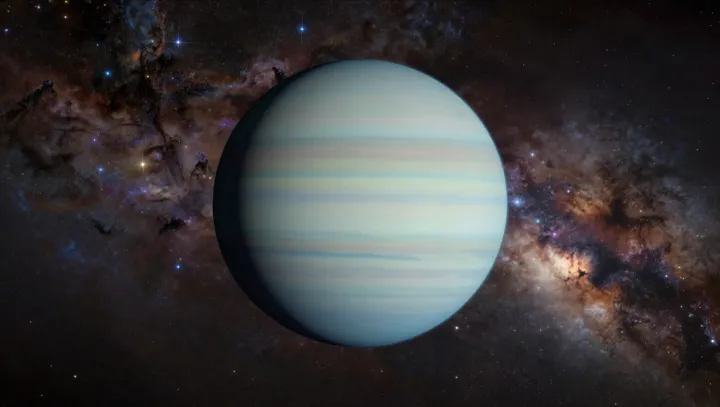
Uranus rolls around the Sun with its spin axis lying almost in the plane of its orbit, so that each pole faces the star for long stretches before vanishing into extended darkness. The planet’s ninety‑eight‑degree tilt turns seasons into slow, alternating episodes of polar illumination and night.
Most models trace this geometry to a giant impact during the chaotic phase of planetary formation, when collisions redistributed angular momentum like an extreme version of a spinning skater changing posture. A body with roughly planetary mass could have struck Uranus off‑center, reorienting its rotation axis while leaving its orbital path around the Sun broadly intact. Simulations of N‑body dynamics show that one such oblique collision, or a sequence of smaller ones, can reproduce the current tilt without violating constraints from the planet’s mass, radius and rotation period.
The consequences extend deep into the planet. A violent impact could have reshaped the internal density profile and altered convection, affecting the magnetic dynamo that generates Uranus’s offset, tilted magnetic field. Gravitational interactions with a transient disk of debris and with forming moons would then have damped residual wobble, a process akin to entropy increase in a closed system, locking in the new obliquity. The same event likely seeded the present ring system and satellite architecture, turning Uranus into a long‑term record of early solar system collisions.
In the quiet geometry of that tilted orbit, every drawn‑out season still carries the signature of that ancient, unseen blow.