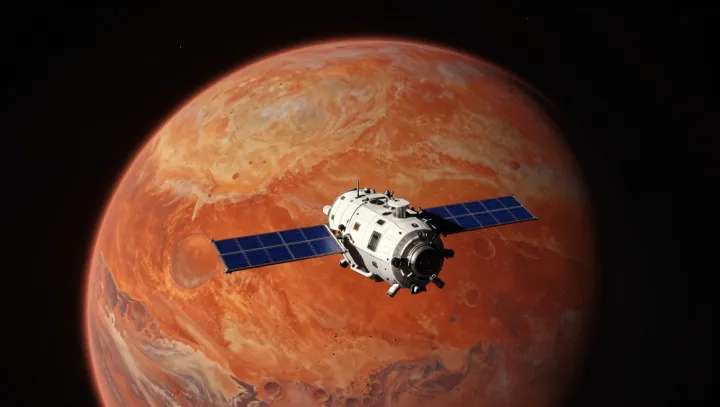
Mars looks like a planet that underperforms. Its mass is far beyond that of any moon, yet its satellite system is just Phobos and Deimos, each closer in size to a city than a world. The key is that gravity is not only about how big a body is; it is about how that pull competes with the parent star and with orbital energy already stored in passing objects.
The blunt truth is that Mars sits in a bad neighborhood for moon building. Its Hill sphere, the region where its gravity dominates over the Sun, is modest for a planet, so long term stable orbits are limited. When small bodies from the asteroid belt strayed near, Mars did not sculpt them from a disk as Earth likely did with its single large moon; it probably grabbed leftovers already on heliocentric paths. That kind of capture, governed by orbital mechanics and three body dynamics, strongly favors small, slow, tightly bound objects and rejects large ones that carry too much kinetic energy to shed.
Mars then treats its prizes harshly. Strong tidal forces act on Phobos in particular, draining orbital energy and pulling it inward, while Deimos drifts outward more gently. No large, loosely held moon could survive such competing torques and solar perturbations for long inside this constrained gravitational pocket. What remains are two battered, potato-shaped survivors, more like borrowed asteroids than proud native moons.