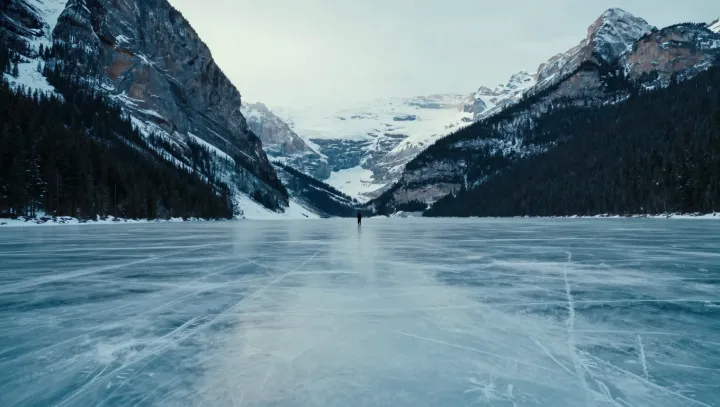
Hard ice, paradoxically, is the best ally of clear water. When a lake surface cools slowly and uniformly, water molecules lock into a hexagonal crystal lattice that resists cracks yet stays optically ordered enough to transmit and reflect light with minimal distortion. Tiny air bubbles and mineral grains, the usual culprits of milky ice, stay scarce if the water is low in sediment and the freeze is calm, without wind-driven slush or snow churned into the forming sheet.
So a person can walk on that frozen sheet while light behaves almost as if the lake were a polished lens. The load from a human body spreads through the elastic ice layer, which can bear significant stress before failure, while photons pass through channels between crystals and return upward as a clean reflection. That mirror-like surface lets scientists treat the lake as a giant horizontal reference plane, measuring how incoming solar radiation is scattered, absorbed, and polarized by aerosols and water vapor in the air above.
The real surprise is how little the ice itself matters to those optical experiments. What counts is the suppression of surface roughness and turbidity, because any random microstructure would add unwanted scattering and mask subtle atmospheric effects. By turning a wild body of water into a temporary, load-bearing optical bench, a frozen lake blurs the line between wilderness and laboratory.