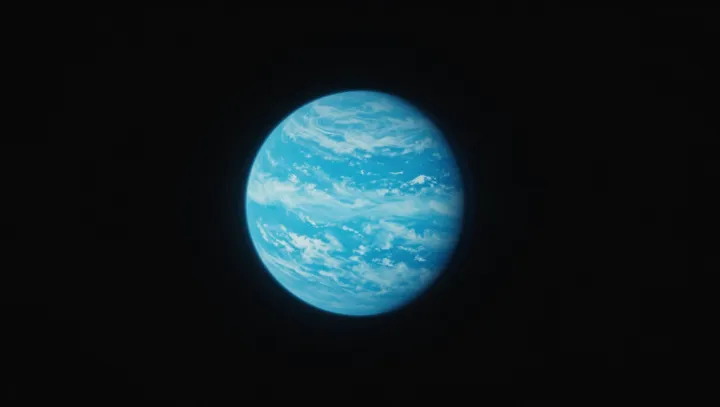
That pretty blue disk is often a warning label, not a comfort blanket. Soft white clouds and oceanic color usually mean a thick, energy‑loaded atmosphere sitting on top of a vast heat reservoir, a setup that physics turns into violence. When stellar radiation pours into the upper layers while infrared cooling bleeds energy from below, the result is strong vertical convection and fierce wind shear, not serenity.
The harsher truth is that uniform color hides brutal gradients. Gas giants tinted blue by methane, or water‑rich super‑Earths with deep global oceans, can sustain enormous pressure at depth, so storms have hundreds of kilometers of vertical room to grow. Rapid planetary rotation feeds these systems through the Coriolis force, stretching storms into long bands and locked vortices, while baroclinic instability converts temperature contrasts into organized cyclones that can dwarf entire terrestrial continents.
Even the gentle look of hazy cloud decks is often a mask for chemistry on the edge. High‑altitude aerosols may form in atmospheres rich in hydrogen, carbon monoxide or sulfur compounds, where photodissociation and recombination drive continuous energy release. Under those clouds, supersonic jets, shock waves and extreme thermal inversions can coexist with the postcard surface color, reminding observers that aesthetics tell almost nothing about habitability.