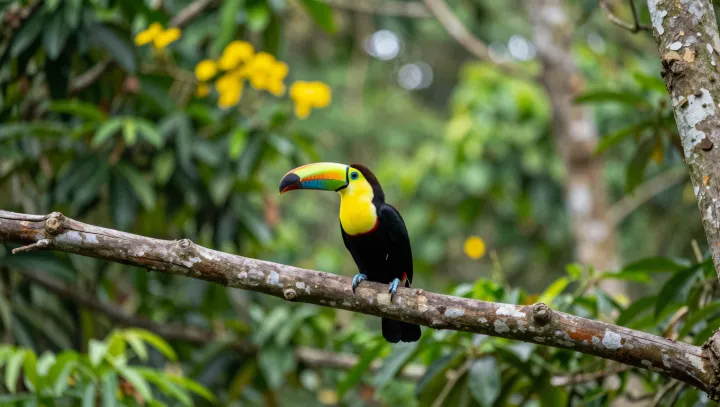
A toucan’s beak looks like a weapon but behaves more like exposed plumbing for heat. Under the bright shell sits a surprisingly austere structure: a thin outer layer of keratin wrapped around a rigid yet airy foam of mineralized struts, a design that slashes weight while preserving stiffness and impact resistance.
Central to its role as a radiator is blood, not bite force. Dense vascular networks thread through the beak’s interior, linking it to the bird’s core circulation so that warm blood can be shunted in or out. When body temperature rises, vasodilation in these vessels increases blood flow; when the air is cooler than the bird, that extra surface area turns into an efficient site for convective and radiative heat loss.
Engineering hides in the geometry. The internal foam forms a trabecular architecture, similar in concept to cancellous bone, which maximizes surface area for heat transfer while keeping mass low. The beak’s high emissivity, coupled with its large area‑to‑volume ratio, lets it dump a sizable share of metabolic heat without the energy cost of panting or the drag of larger wings.
What looks like flamboyance is really thermal management hardware. By outsourcing much of its thermoregulation to this hollow, vascular shell, the toucan keeps flight feasible, muscles protected and brain temperature controlled, turning a cartoonish profile into a quietly efficient piece of biological engineering.