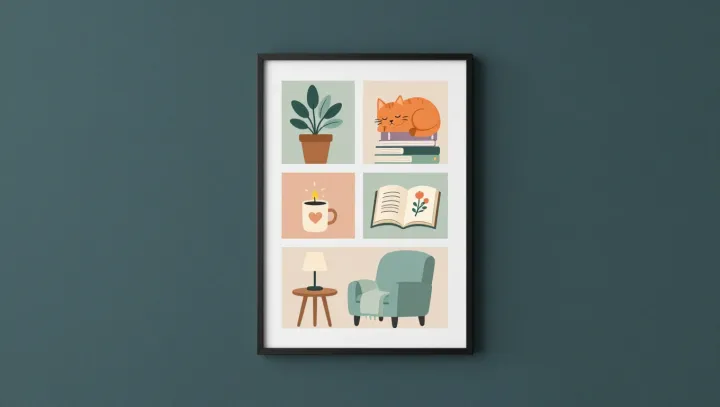
A cozy icon poster often beats a lavish illustration in the only gallery that matters: your memory. This is not about taste; it is about compression. Visual cognition runs on ruthless data reduction, trimming scenes into a handful of salient cues that can be stored with minimal metabolic cost.
Your brain, biased and efficient, prefers a bold mug outline and a warm color block over every steam swirl and porcelain crack. In the primary visual cortex and inferotemporal cortex, neurons act like feature detectors, locking onto simple contours, color contrast, and familiar silhouettes. The more an image aligns with these canonical features, the easier it is to encode and later reconstruct a recognizable scene from fragmentary input.
Emotion quietly rigs the contest. A soft palette, a rounded chair icon, a single glowing lamp: each becomes a high-priority token in episodic memory, amplified by limbic circuits such as the amygdala. Hyper-detailed art spreads that emotional charge across hundreds of tiny elements, so none of them wins the internal competition for storage. The icon poster, stripped and cozy, gives your memory fewer pieces, each carrying more weight.