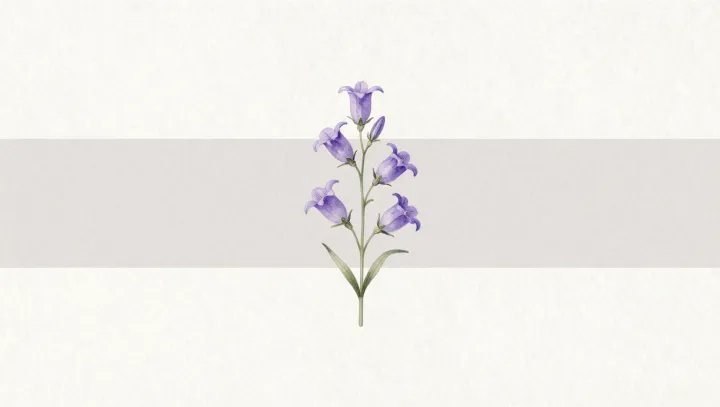
A drooping bell, not a bright petal, turns out to be the real gatekeeper of pollinators. In a controlled series of orientation manipulations on woodland bellflowers, researchers physically rotated blossoms so that naturally nodding flowers faced upward and naturally upright ones were forced to hang, then tracked which insects visited and how much pollen they carried away.
The surprising part is how directional this filter is. When corollas pointed down, hoverflies still visited but deposited little conspecific pollen, while bumblebees and larger bees brushed past anthers and stigmas in a tight corridor that maximized contact. Flip the same blossom upward and the geometry of access changed, shifting pollen placement on insect thoraxes and abdomens and letting different visitor guilds, including less efficient beetles, dominate the effective pollination network.
What looks like a minor architectural tweak is in fact a classic case of functional morphology. Flower orientation, working together with floral tube length and anther position, reshapes the three dimensional contact zone between reproductive organs and insect bodies, a process botanists describe using terms like pollen transfer efficiency and pollination niche partitioning. From that modest woodland bellflower, evidence now points to gravity as a quiet but persistent selector, nudging blossoms into matching not just any visitor, but the right one.