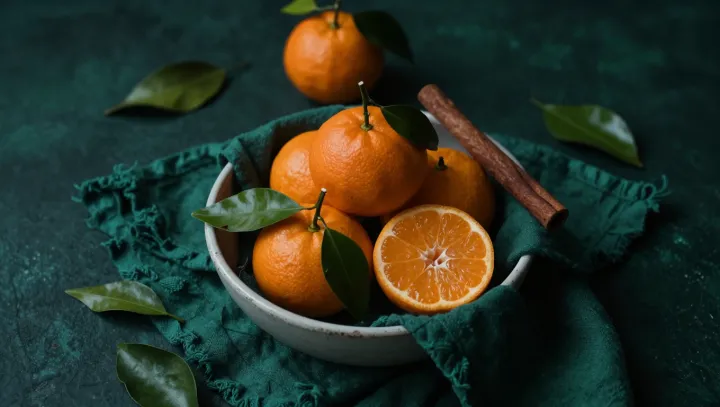
These oranges refuse sweetness. Set against a spare ground, their peel catches light in small ruptures while attached leaves interrupt the usual market polish; the composition makes freshness look almost defiant, as though harvest had pushed through the studio wall. Nothing is accidental. It feels unsettled. By allowing a bent leaf to remain visible, the arrangement declines the sterile promise of retail display and turns imperfection into visual evidence. A low color temperature reins in orange saturation, and the branches cast narrow shadows that give the fruit mass rather than mere shine.
The leaves do the real work. Without them, the fruit risks becoming a catalog specimen; with them, the image carries a trace of botany, where chlorophyll, stem tension, and minor abrasions argue against cosmetic perfection. That friction matters. In still-life photography, specular highlights can flatten a curved surface, yet the foliage interrupts glare, establishes negative space, and leads the eye from blunt abundance toward the cut stems.
The strongest choice is restraint. No prop competes, no hand enters, and no decorative cloth offers an easy story; instead, chiaroscuro lets the fruit appear both offered and withheld, a familiar object made stern by attention. The silence holds. That is the quiet wager. The branch is a small witness, neither decoration nor proof, but a thread connecting the polished scene to weather, weight, and removal. What remains is not a lesson about produce, but a question posed by the leaf edges: how much life must an image retain before it stops behaving like an object?