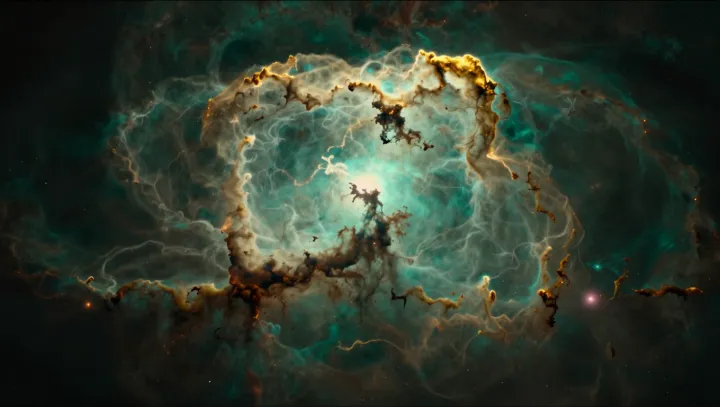
A spinning black hole turns space-time into a cosmic vortex, pulling nearby light into tight, swirling tracks while distant stars shine as if nothing were happening. The effect is not a metaphor but a direct consequence of general relativity, encoded in the Kerr metric that describes rotating black holes.
Rotation gives the black hole angular momentum, which generates frame dragging: space-time itself is forced to co-rotate in the region around the object. In this ergosphere zone, no photon can remain still relative to the distant universe; every light beam must follow bent geodesics, the natural paths in curved space-time. These geodesics can loop, skim the photon sphere, or spiral inward, creating the appearance of a luminous whirlpool captured in simulations and in high-resolution images of black hole shadows. Gravitational lensing then magnifies and distorts background light passing close to this warped region.
Far from the black hole, the gravitational potential weakens and the frame-dragging term becomes negligible, so space-time approaches the flat geometry of special relativity. Light from distant stars travels along almost straight geodesics and ignores the twist, just as a gentle swirl in a river leaves the far bank undisturbed. The universe keeps its calm surface while, in a small neighborhood, space-time quietly spins itself into a knot.