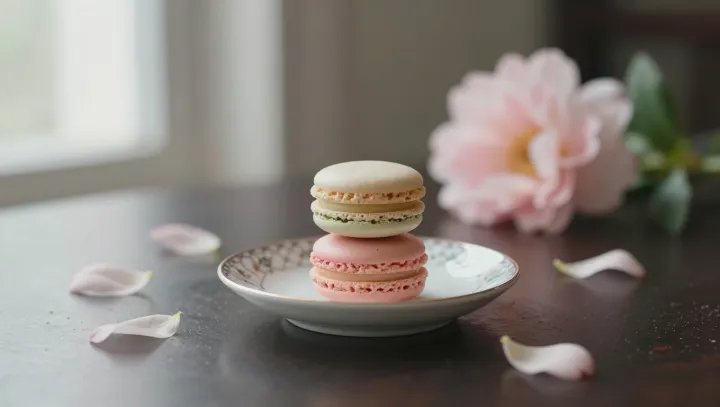
A narrow strip of sugar temperature, barely a degree wide, decides whether your macarons emerge as shattered husks or smooth, bakery‑level shells. When syrup for Italian meringue hovers at the upper edge of the soft‑ball stage, proteins and air behave like a disciplined system instead of a chaotic one.
At that point, sucrose concentration is high enough to raise glass transition temperature but still low enough to avoid hard‑crack behavior. Hit that slim band and you get a syrup that flows into whipped egg whites, driving controlled protein denaturation and stable foam formation. Miss it by a degree lower and water activity stays too high, so steam expansion during baking overwhelms the fragile protein network and blasts hollows under the cap.
Push the syrup a degree higher and you drift toward hard‑ball physics: the sugar matrix stiffens too early, shrinking the margin for thermal expansion. Air cells cannot redistribute pressure and the shell fractures or domes unevenly. In that constrained window, entropy feels temporarily slowed; energy input, moisture loss and structural set reach a momentary equilibrium that the home oven can reproduce with surprising reliability.
For professionals, that degree becomes a form of process control, as central as tracking baseline temperature or monitoring marginal effects in an economic model. For home bakers, it reduces a ritual of superstition to a measurable variable on a thermometer, turning a temperamental dessert into a repeatable act of precision.