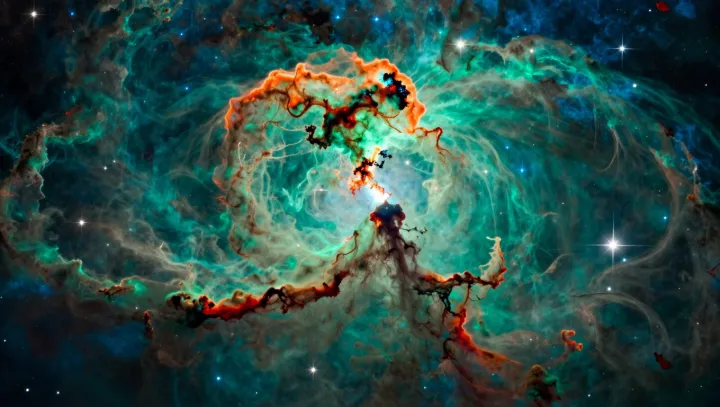
A supernova remnant that looks frozen in astronomical images is in fact a rapidly changing structure. Its glowing nebula is a brief phase, fading and dispersing into the interstellar medium over only tens of thousands of years, a timescale that is short in galactic terms.
The expanding shell is driven by a shock wave plowing through surrounding gas and dust, heating plasma to extreme temperatures and producing bright emission lines. As the shock slows and radiative cooling dominates, the gas density drops, ionization levels fall, and the nebula’s surface brightness declines. High resolution imaging and spectroscopic surveys allow astronomers to map this evolution, measuring expansion velocities, energy dissipation, and changes in chemical abundances that trace nucleosynthesis products from the original star.
Over time, turbulent mixing and diffusion erase the sharp edges that once outlined the remnant. Filaments that appear crisp in one set of images become faint arcs in later observations, eventually blending with the diffuse background of the galaxy. What began as a compact, high contrast shell of shocked material turns into a nearly imperceptible enhancement in the local interstellar medium, leaving behind only enriched gas that will one day participate in new cycles of star formation.