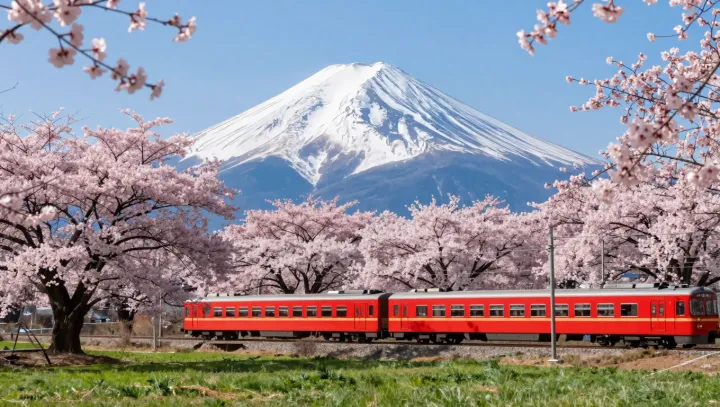
One train window in spring Japan turns into a compressed archive of time. Outside the glass, cherry trees flare into bloom and prepare to vanish almost as quickly, their petals tracing what biologists would call a high metabolic rate of the landscape itself. The blossom cycle starts, peaks and declines within a narrow biological window, making the pink fringe along the tracks feel like a live chart of accelerated entropy.
Behind that fragile strip of color, Mount Fuji holds the frame, a reminder that volcanic uplift and erosion operate on a completely different temporal scale. The cone is the cumulative product of plate tectonics, magma chambers and gradual weathering, a structure that encodes uncounted cycles of deposition and collapse. Its apparent stillness is only a function of human perception, not of the underlying geophysical processes that continue to reshape its slopes molecule by molecule.
Cutting between these two timelines, the carriage itself adds a third: the ceaseless flow of passengers using rail infrastructure to convert distance into opportunity. Timetables, commuter routines and tourism patterns create their own marginal effects on where people live, work and spend. In one moving rectangle of glass, rapid biological bloom, deep geological formation and restless human mobility coexist, each running its own clock yet sharing the same view.