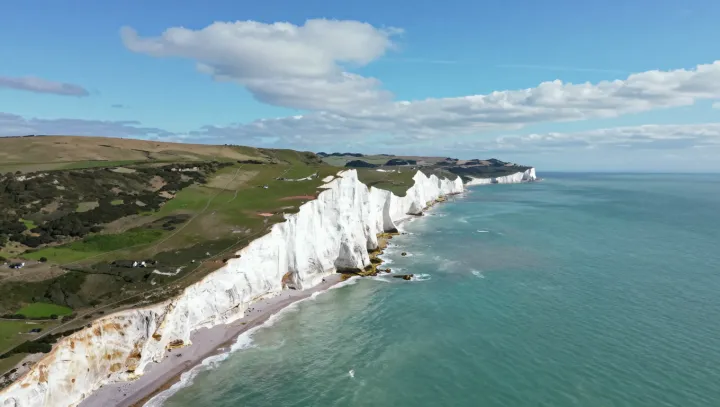
White chalk towering above the English coast is not a single rock but a packed archive of dead plankton. Each layer formed as shells of coccolithophores and foraminifera sank, piled up on the seafloor, and slowly lithified under pressure into calcium carbonate. Over long spans, steady deposition created a thick, coherent stratigraphic column that functions like a continuous ledger of ocean conditions.
Within that column, tiny differences in grain size, fossil species and mineralogy track shifts in sea level, temperature and ocean acidity. Ratios of oxygen isotopes and carbon isotopes inside the shells encode signals of global ice volume and the carbon cycle, giving researchers a direct handle on paleoclimate forcing instead of relying on anecdotal surface evidence. Because erosion exposes the layers almost like pages on a vertical core, scientists can sample them in sequence and calibrate climate models against a physical record.
The clarity of that record depends on low sediment disturbance, relatively constant accumulation rates and the chemical stability of calcium carbonate. In this setting, bioturbation and tectonic disruption remain limited, so the cliff preserves fine stratification, marker horizons and even abrupt transition bands linked to rapid climate events. Standing at its base, the eye sees a wall of chalk; instruments see a densely coded timeline of environmental change.