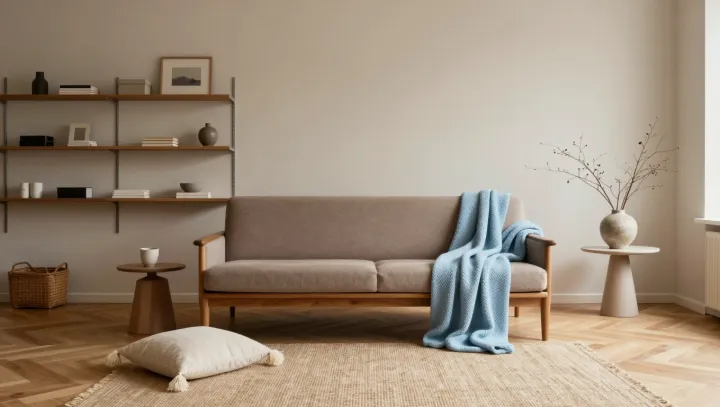
An artful home often looks almost empty, yet the space registers as unexpectedly dense with meaning. This is not a paradox. It is a design strategy that treats every object as a visual sentence in a narrative, rather than a container for more things. Where an average apartment optimizes for storage capacity, an art driven interior optimizes for attention and symbolic weight.
The difference is less about minimalism as a lifestyle and more about information theory. A crowded bookshelf, a stacked sideboard, a busy coffee table all push the visual entropy of a room upward, scattering the viewer’s focus. When objects are edited down, the marginal effect of each remaining piece increases: a chair becomes a character, a lamp a line break, a single ceramic bowl an entire subplot. Negative space functions as punctuation, forcing the eye to read the room as a sequence rather than noise.
Designers and artists speak of curation, but in these homes curation behaves almost like a baseline metabolism for the space: constant selection, rejection, and recombination of matter to keep the visual system lean. Practical storage is hidden or pushed to the background, so that what stays in sight is there to advance the story. The result is not an absence of things, but a redistribution of meaning into fewer, clearer statements.