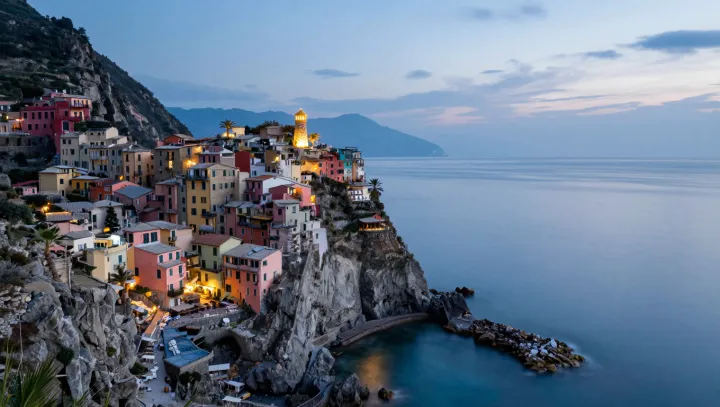
Stone cliffs facing a restless sea were first chosen as a shield, not as a shelter. Medieval engineers piled walls on this jagged coastline to control sightlines, narrow access routes and exploit natural elevation. What they could not model was how the same rock faces and onshore winds would later lock a small village into an unusually steady pocket of air, light and temperature.
Researchers now describe the site as a textbook maritime microclimate, governed by thermal inertia in the rock and a local boundary layer that behaves like a soft lid over the settlement. The cliff’s fractured geology stores heat and slowly releases it, damping diurnal temperature swings. Persistent sea breezes drive convective mixing along the slopes, preventing cold air pooling and sharp inversions that would normally fade pigments and stress building materials.
Wind tunnels between headlands channel airflow in a quasi-laminar pattern over the roofs, while the cove-like geometry reduces turbulent shear at street level. That combination stabilizes relative humidity and limits salt crystallization, a key process in material weathering. Radiative balance across the pastel facades stays within a narrow band, so paint layers experience low thermal stress and slower photochemical degradation, keeping color saturation unexpectedly high.
Cliff height, aspect and sea-surface temperature together create a small-scale feedback loop in local atmospheric circulation: warm rock surfaces promote gentle updrafts that pull in cooler marine air, which then slides along the walls rather than slamming into them. The result is a village that looks curated by design, yet its enduring palette is mostly an emergent property of rock, wind and water, not of any plan those early fortification builders ever drew.