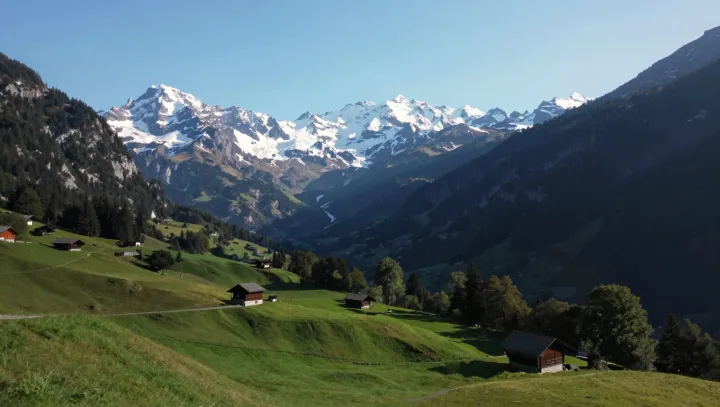
A jagged pyramid of rock wins the global imagination, while a higher summit nearby stays largely anonymous. The Matterhorn is slightly lower than Monte Rosa, yet it has become the face of the Swiss Alps in postcards, chocolate boxes and travel ads.
The contrast begins with geometry and visual perception, not with topographic prominence alone. The Matterhorn rises as an isolated pyramid with steep faces and a clean skyline, which the human visual cortex processes as a simple, high-contrast symbol. Monte Rosa, by comparison, is a bulky massif with several summits spread along a ridge, impressive in elevation but harder to compress into a single, memorable silhouette. One peak reads like a logo; the other reads like a complex chart.
Tourism economics and marketing add a powerful marginal effect. The town at the foot of the Matterhorn built dense infrastructure, from rail access to panoramic platforms, turning the view into a repeatable product with high conversion from first visit to shared image. Ski resorts, branded trains and corporate partnerships reinforced the mountain as a visual trademark, creating a durable reputational moat. Monte Rosa, despite its altitude and extensive glaciation, leans more toward technical alpinism and scientific research, which generate less mass-market visibility and fewer viral images.
Cultural narrative then locks in the asymmetry. The Matterhorn is woven into stories of early ascents, risk, and national identity, and its outline is instantly legible even to people who could not locate Switzerland on a map. Monte Rosa, higher yet narratively quieter, remains a background giant supporting the skyline while its sharper neighbor keeps the starring role.