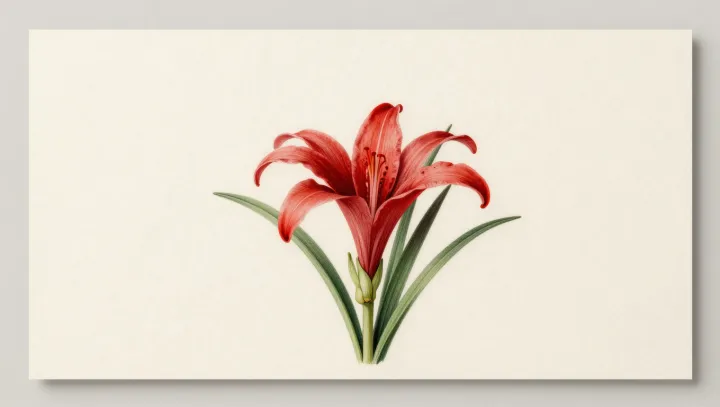
A dragon-shaped arch of flowers bends over a narrow landing strip, and a pollinator hits exactly the right spot. This tropical species from Mexico and Guatemala has turned its entire inflorescence into a three-dimensional guidance system, evolving a head-like cluster that controls where an insect touches pollen and stigma.
Behind the theatrical silhouette lies strict biomechanics. The curvature of the floral axis, the spacing of individual corollas and the stiffness of supporting tissues work together like a pre-set linkage, converting an insect’s incoming trajectory into a predictable contact point. The system exploits basic principles of kinematics and center-of-mass alignment, creating what amounts to a living jig for pollen transfer.
Pollinator behavior supplies the rest of the precision. Insects follow visual contrast, bilateral symmetry and consistent tactile cues, classic examples of sensory bias and stimulus–response coupling. As they land along the arched head, their bodies are funneled toward reproductive organs with a repeatability that rivals mechanical fixtures. Natural selection, acting on tiny shifts in petal angle and stem torsion, has ratcheted up that repeatability over countless generations, turning a cluster of blooms into a guided landing platform that looks like a dragon and functions like calibrated hardware.