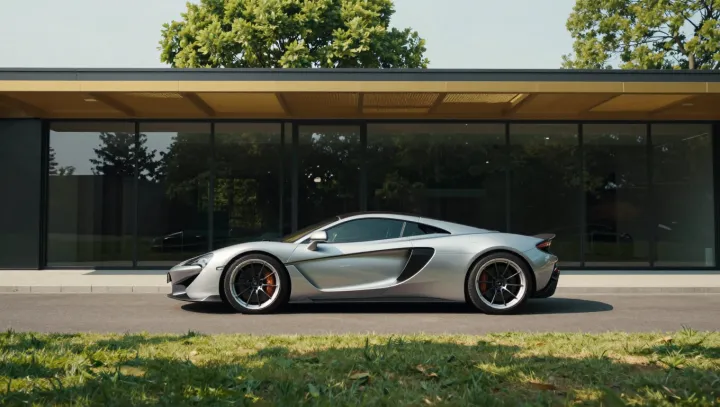
A track-only Ferrari that cannot race sounds like a paradox until you look at the bodywork. Freed from homologation, balance-of-performance tables and minimum ride-height rules, the car becomes an aerodynamics test rig on slick tyres. Every surface is drafted around airflow management, not around regulations or class politics.
The decision to step outside sanctioned racing is strategic rather than eccentric. Without rulebook drag, engineers can chase extreme downforce coefficients and pressure differentials that would never pass a scrutineer. Computational fluid dynamics and wind-tunnel data drive the form, so the body is sculpted to maintain attached flow even as speed, yaw angle and brake temperature fluctuate, treating the car as a moving experiment in fluid dynamics rather than a conventional model line extension.
That freedom explains the moving vents that open and close like valves in a circulatory system, actively managing boundary-layer separation and thermal load. The glass-and-body dome is treated as a single aerodynamic volume, not a canopy pasted into a shell, smoothing the stagnation point over the nose and feeding cleaner air to the rear devices. The result is a rolling demonstration of applied Bernoulli principle and vortex generation in which aesthetics are almost a side effect of the aero brief.