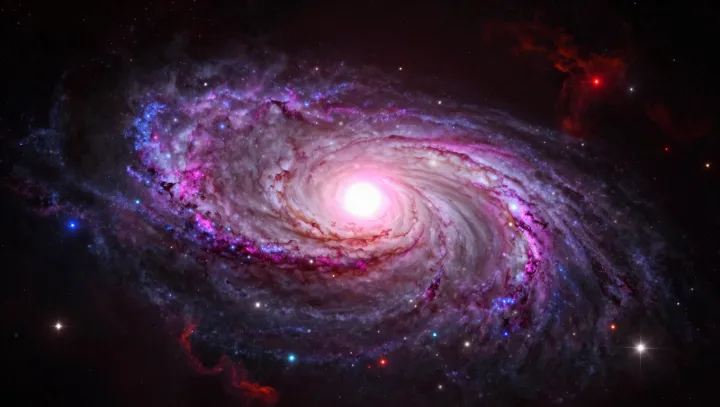
A sky punched with stars does something sneaky to your mind. Not by adding meaning, but by stripping your problems of their monopoly on attention, it changes how your internal stress machinery allocates resources.
Psychologists call this state awe. Short word, heavy effect. During awe, imaging studies show reduced activity in the default mode network, the set of regions tied to self-referential thought and rumination. When those circuits quiet, the prefrontal cortex stops rehearsing the same grievances, and cortisol output can drop. Your issues do not vanish, but the neural spotlight swings away from them, which feels like relief inside the same skull.
Cosmic scale also hacks your built-in sense of proportion. The visual cortex and parietal lobe process that almost absurd depth overhead, and the brain updates its mental model of size and relevance. Personal setbacks, once framed as total, are instantly re-coded as local anomalies inside a much larger reference frame. That re-scaling, known as cognitive reappraisal, is a core mechanism in clinical emotion regulation, yet the night sky hands it to you without a therapist.
There is a final twist. Feeling smaller in a structured universe can feel safer than feeling large in a chaotic one. Astronomical order, from gravitational dynamics to cosmic background radiation, signals pattern and stability. For a moment, your life looks less like the center of a crisis and more like one data point in a vast, coherent system.