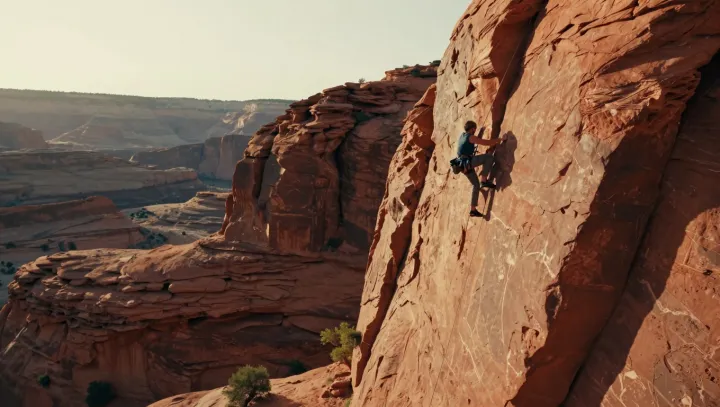
Rock does not care about your training plan. Every ripple, crack and color shift presents a decision, and that irregular surface forces outdoor climbers to run a nonstop visual audit of what might hold body weight, what might shear off, and what simply wastes skin.
Indoor walls, by contrast, are edited stories. Routesetters preselect holds, telegraph sequences with color coding, and remove most ambiguity; the climber’s brain can lean on pattern recognition instead of raw inference, so perceptual load and risk calculation stay low even when the grade feels high. Outside, there is no color logic, only probabilistic judgment built from friction, mineral texture, micro-features and prior experience, which means continuous activation of visual cortex, motor planning networks and working memory.
This is why outdoor climbers often report sharper cognitive fatigue at moderate difficulty than they ever feel on gym limit attempts. On real rock, every move demands route reading, fall consequence analysis and force vector estimation, blending biomechanics with environmental uncertainty. Indoors, repetition on standardized holds creates something closer to a laboratory task: controlled variables, narrow solution sets, low signal noise. The gym builds strength and basic movement vocabulary; the cliff spends that strength on a three-dimensional puzzle that never repeats itself.