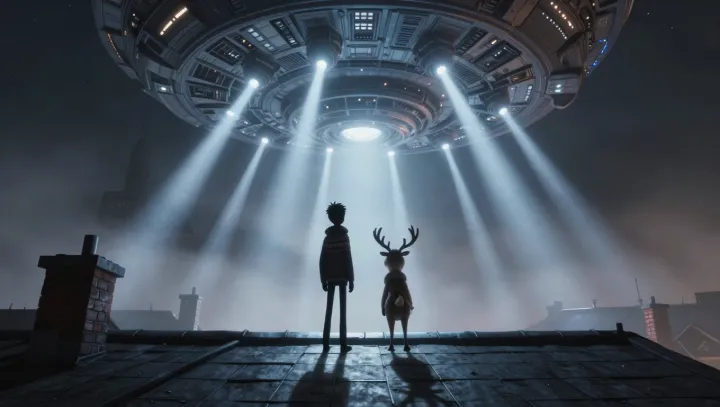
The film’s big joke is simple: Santa runs a black-ops logistics outfit. Under the jokes sits a near-textbook model of what it takes to move millions of units through a finite window without collapsing the system or exposing the trick. The opening raid sequence lays out a full-stack operation: stealth transport, synchronized ground crews, real-time tracking, and ruthless standardization of every micro task.
The story’s real tension is not magic, but throughput. The vast sleigh-ship behaves like a flying distribution center, built around capacity planning and queue management, while the North Pole command room functions as a control tower for dynamic routing and exception handling. Dashboards, geolocation feeds and countdown timers mimic a network operations center, where every deviation is treated as a fault that must be isolated before it cascades.
The film’s most honest move is failure. One missed child becomes a classic edge case, exposing brittle assumptions, single points of failure and weak redundancy. Arthur’s improvised trip with the obsolete wooden sleigh reads like a stress test of resilience engineering, showing that backup pathways, manual overrides and human error tolerance matter as much as glossy automation if the illusion of seamless magic is to survive contact with reality.