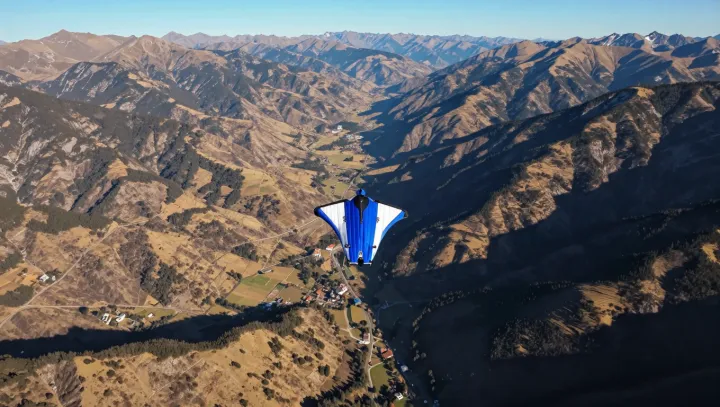
The paradox of wingsuit flying is that it feels expansive while the physics stay brutally tight. A modern suit can reach a glide ratio of roughly three to one, yet that extra horizontal distance does not buy much time once rock, trees or ground fill the visor. At typical speeds approaching highway traffic, a loss of only a few meters in altitude can occur in a blink during a shallow turn or a tiny pitch change.
What really shrinks the safety margin is not romance but numbers. Dynamic pressure, described by one half rho v squared, rises sharply with speed, so any abrupt control input loads the fabric wings and shifts the airflow in ways that can stall a section of the suit. Because the wing is your entire body, a partial stall instantly changes both lift and drag, steepening the flight path just when a flyer is already skimming terrain for proximity lines.
The harsh truth is that error bars in this sport are measured in angles, not feelings. A pitch error of only a few degrees can convert a stable glide into a descent rate that outpaces available altitude, while impact energy scales with the square of velocity, leaving almost no survivable buffer. What looks like generous airspace from a helmet camera is, in aerodynamic terms, a narrow corridor carved through gravity.