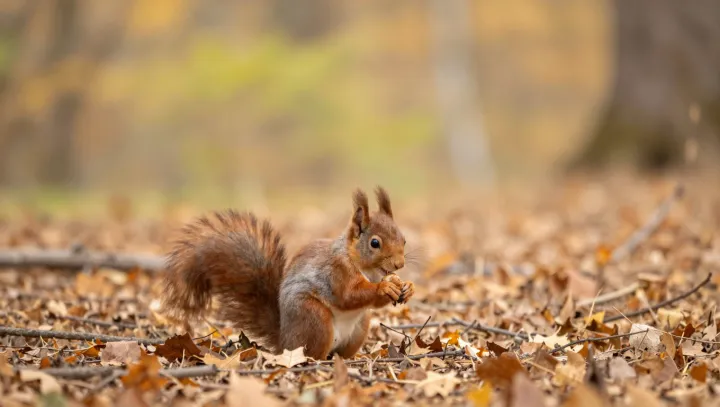
Charred trunks and ragged canopies built the first real squirrel opportunity. In the biological wreckage after the dinosaur era, small rodent ancestors slipped into the trees, using disrupted forest structure the way a street vendor uses a sudden empty corner: as territory nobody powerful was guarding anymore.
This origin story challenges the cute‑mascot image; squirrels are products of disaster ecology. Fossil dentition shows early members of the squirrel lineage with sharpened incisors and increasingly specialized cheek teeth, a textbook case of adaptive radiation driven by seed and cone resources in recovering conifer and mixed forests. Comparative anatomy links their elongated hindlimbs and reinforced ankle joints to an arboreal niche where vertical escape routes replaced open‑ground sprinting and rewarded precise leaping between unstable branches.
More striking is how cognition followed muscle. Neuroanatomy studies, tracking relative brain volume and enlarged hippocampal regions, indicate selection for spatial memory as these rodents cached seeds in complex three‑dimensional habitats. Phylogenetic analyses now group tree, ground, and flying squirrels within a single clade that traces back to those early post‑catastrophe generalists, turning a brief evolutionary window of chaos into a long, global experiment in agility and memory.