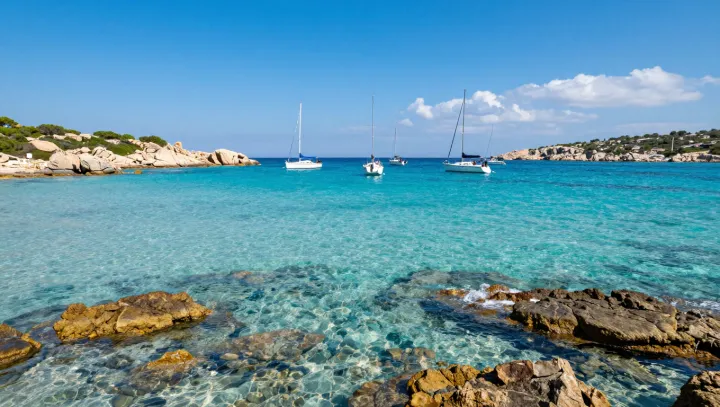
Silence, not surf, is the first surprise around these granite piles. Where charts hint at exposure, the sea surface lies oddly glassy, because the rock cluster acts less like scenery and more like a breakwater engineered by slow geology.
The key is shape, not romance. As incoming swell meets the steep granite faces, wave refraction kicks in, bending long-period waves around the outer blocks so their crests intersect and cancel in the lee, while diffraction leaks only low-energy ripples into the pocket behind. That same mass forces a pressure gradient in the boundary layer of water around it, slightly deflecting tidal currents so they shear past the outer flanks instead of scouring the anchorage floor, leaving a patch of relatively uniform sediment where anchors hold with unusual consistency.
Air is tamed here as well. Rather than a gentle breeze, sailors outside feel a confused blast, because the boulders split the prevailing wind into jets that accelerate through gaps and then stall just behind them, a textbook example of flow separation and wake formation turning what should be a gusty lee shore into a narrow calm strip. In that strip, hulls swing slowly, loads on anchor chains drop, and the entire geometry of rock, water and wind behaves like an invisible shield that no harbor engineer could justify building, yet every passing skipper quietly trusts.