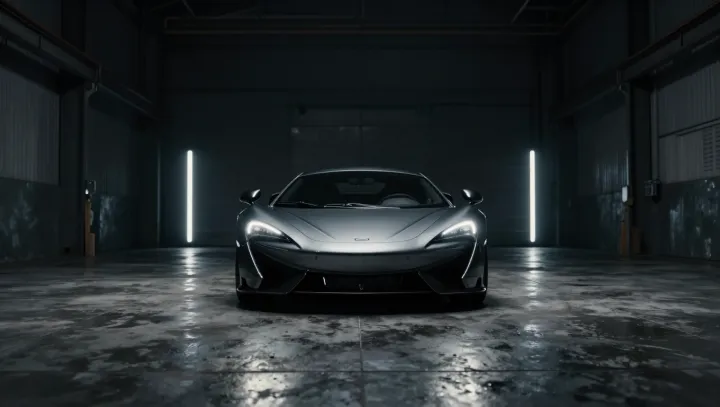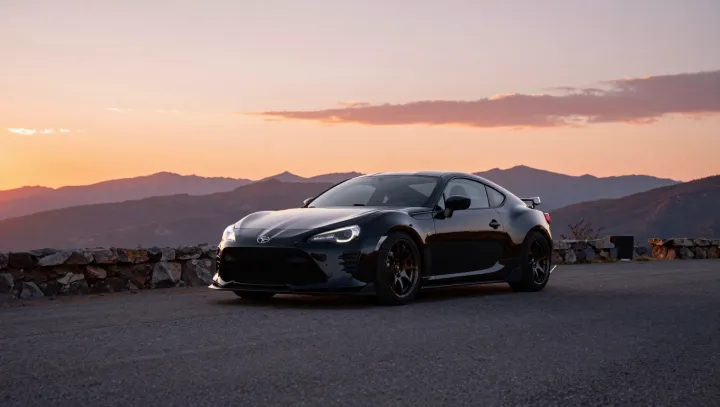
The car does not change; your visual system does. Against a glowing horizon and hazy mountains, the scene pushes contrast to an extreme, and contrast is the one metric your eyes reward with extra attention.
Harsh? Yes. But the physics agrees. Low-angle sunset light travels through more atmosphere, so shorter wavelengths scatter and longer, warmer wavelengths dominate. That soft, directional beam acts like a giant studio key light, carving bright specular highlights along the coupe’s roofline and fenders while leaving adjacent panels in relative penumbra. The black paint, which absorbs most incident light, deepens those shadows, so every curvature becomes a high-contrast boundary against the sky and the distant, desaturated terrain.
The bigger exaggerator sits in your head. The visual cortex leans heavily on lateral inhibition and edge detection, classic textbook mechanisms that heighten differences at boundaries while muting uniform regions. When the background is a smooth gradient of orange to violet and the mountains are softened by atmospheric perspective, the brain has few internal contours to process, so the crisp silhouette of the coupe gets priority in the neural queue. Short, bright reflections on glass and metal are then stitched into a single, coherent outline, which your perception upgrades into a sense of extra sharpness and precision, even though no molecule of paint has moved.