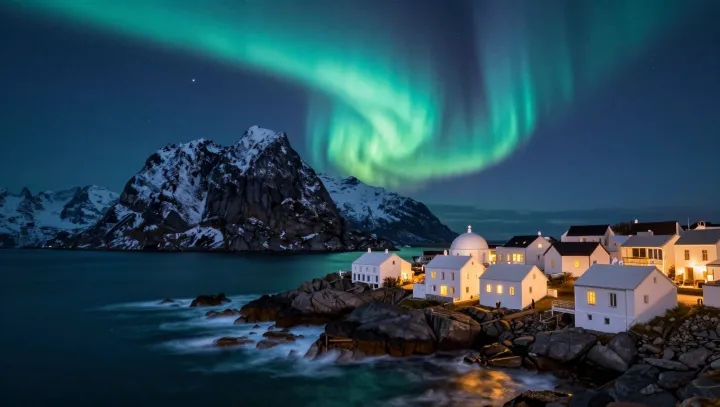
Darkness does not peak in deserts or deep caves; it peaks above sea ice and shuttered boats. Over a silent Arctic fishing village, the Sun never rises, so direct photons vanish and the sky’s natural background drops to a level that light pollution researchers call extreme, measured in single-digit microcandelas per square meter. Houses sit unlit. Snow absorbs what little starlight arrives. The village becomes a laboratory for what happens when the Sun steps out of the scene yet still controls it.
The bright part starts far away, and that is the twist. Long before villagers watch the sky, eruptions on the solar photosphere hurl plasma into interplanetary space, building a solar wind that carries energetic electrons and ions. Those charged particles ride magnetic field lines into the magnetosphere, then funnel down toward polar regions like freight on invisible rails. When they slam into atoms and molecules in the upper atmosphere, they trigger electron excitation and photon emission, the basic physics behind every fluorescent tube.
So a village that is optically darker than many observatories can be lit, for minutes or hours, with curtains of aurora that photometers rate brighter than city neon. The ground stays quiet. Nets hang frozen. Above, green and crimson arcs mark the delayed arrival of particles that left the Sun days earlier, turning a place of almost perfect darkness into a temporary marquee written in charged gas.