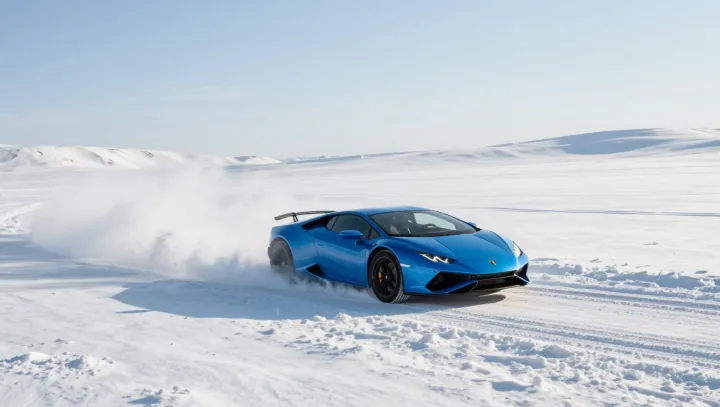
Sideways is not chaos for a modern supercar; sideways is strategy. On ice, a 600 horsepower machine can feel calmer when it drifts, because the slide gives its control systems a clear, continuous signal about where the car is rotating and how fast that rotation builds.
The key claim is blunt: yaw control, not raw grip, now decides who stays on the road. Electronic stability control monitors yaw rate and steering angle, then compares them to a target yaw curve generated by the control algorithm. When the car starts to rotate, software trims engine torque, pinches individual brakes, and shifts power front to rear in milliseconds to hold that target like a tightrope.
Even more counterintuitive is how torque vectoring turns a drift into a guided arc. By overdriving the outer wheel and easing the inner one, the system creates a deliberate yaw moment, exploiting friction circle limits instead of fearing them. Once the car is at a steady slip angle, the state becomes quasi linear for the controller, which can meter wheel torque and brake pressure with far less uncertainty than in the twitchy, half‑grip phase that unnerves human drivers.
What looks like flamboyant oversteer is therefore a managed equilibrium. Sensors feed wheel speed, lateral acceleration, and steering input into a model of vehicle dynamics, and the car quietly solves the equations that a human cannot. The result is a paradoxical feeling from the cockpit: the more the car appears to be out of line, the more precisely its electronics hold the line.