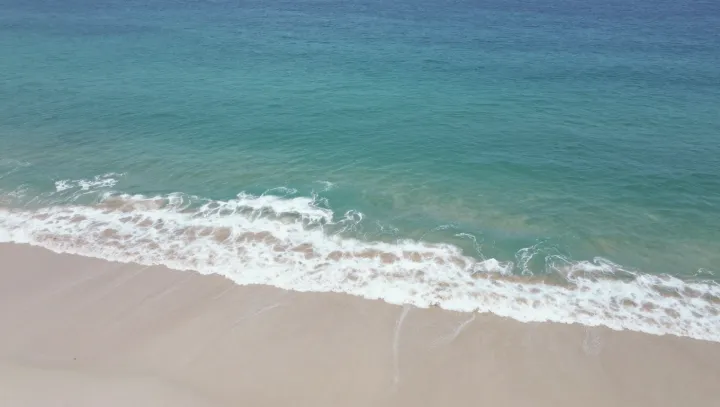
Those soft turquoise ripples are not gentle at all. Beneath the surface, each passing wave behaves like a moving conveyor of momentum, driven by gravity and wind, quietly applying force to every grain of sand it touches along the seabed and the beach face.
The core trick is mechanical, not mystical. As a wave travels, water particles move in orbital motion, tracing small loops that shrink with depth yet still transmit energy forward, and when that orbit meets the bottom, friction and shear stress start to drag sediment, setting up what coastal engineers call bedload transport and suspended load. One wave is trivial. Thousands of waves, arriving from similar directions, produce a persistent push, a kind of horizontal ratchet that never resets to zero.
Coastlines change because this ratchet is rarely symmetrical. When incoming waves strike the shore at an angle, they generate longshore drift, a lateral current that shuttles sand grain by grain along the beach, while wave refraction bends higher energy crests toward headlands and strips them of material. Bays, receiving diminished wave energy due to this refraction, become low energy traps where sand is deposited and stored. So a seemingly still turquoise bay may actually be the archive of countless storm swells that broke far offshore, moved sediment stepwise along the bottom, and then left the shoreline line a few meters away from where a previous generation remembered it.