Blue in blueberries is slightly dishonest, and studio photographers rely on that cheat. What the eye reads as saturated blue is actually structural interference layered over red‑leaning anthocyanin pigments that absorb green and red wavelengths with surprising efficiency.
This double act matters once the fruit enters a minimalist set, where softboxes, diffusion panels, and neutral backdrops leave almost nothing except pigment and physics to talk to the sensor. Anthocyanins, especially in their flavylium cation and quinoidal base forms, show pH‑dependent absorption peaks that carve out very specific bands of the visible spectrum. In practice, that means incoming white light is pre‑edited before it even hits the camera, with short‑wavelength reflection favored and mid‑band energy quietly suppressed.
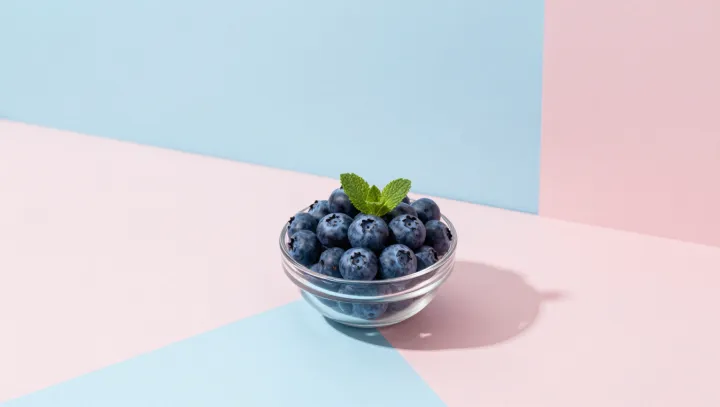
Minimalist images of a single berry on a pale surface look simple, yet they are the product of this spectral negotiation. Under cooler LED panels the pigment’s absorption curve exaggerates cyan notes; under warmer tungsten sources, partial re‑emission and scattering from the waxy bloom push the hue toward muted indigo. Sensor spectral sensitivity and any in‑camera color matrix then compound the effect, so what appears as a clean, graphic blue orb is, in fact, a negotiated compromise between biochemical filter, controlled light, and silicon.