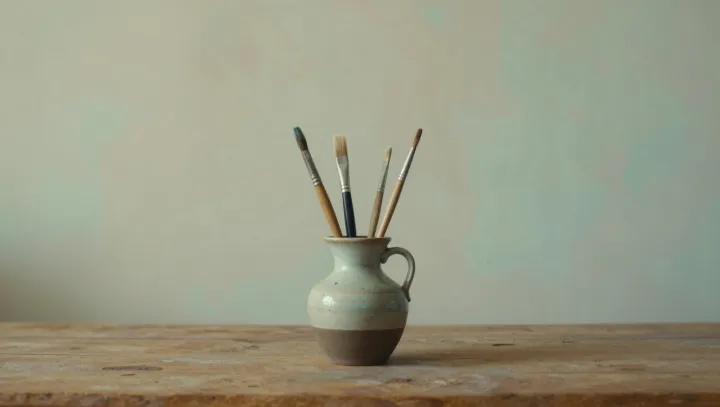
Those crusted brushes are less nostalgic clutter than physical archives of motion. Along each ferrule, dried paint forms a stratigraphy, a layered record whose sequence reflects the order in which strokes were laid down, because each fresh load of pigment flows around and over older, already polymerized films rather than through them.
The surprising claim is simple. Every splatter is directional data. Under magnification, pigment filaments stretch into tiny comet tails, aligned with shear stress vectors that bristles experienced when dragged, snapped, or flicked, a pattern governed by basic rheology and boundary layer flow. Short, abrupt marks leave fractured ridges where viscosity outpaced hand speed; broad, slow arcs smooth those ridges into laminar fans. By modeling these traces through kinematics and inverse dynamics, researchers can reconstruct hand trajectories, including acceleration curves and rotation around the wrist.
Equally revealing is the brush itself. Splayed bristle bundles lock in their final deformation, an imprint of repeated torque and grip angle, interpretable with the same finite element methods used on worn mechanical parts. Cross‑sections of the paint near the heel of the bristles show micro‑bubbles and voids that correspond to loading frequency, almost like a low‑fidelity seismograph of studio gestures. What looks like random mess becomes a slow, silent recording of how thought turned into movement, then into matter, and finally into evidence.