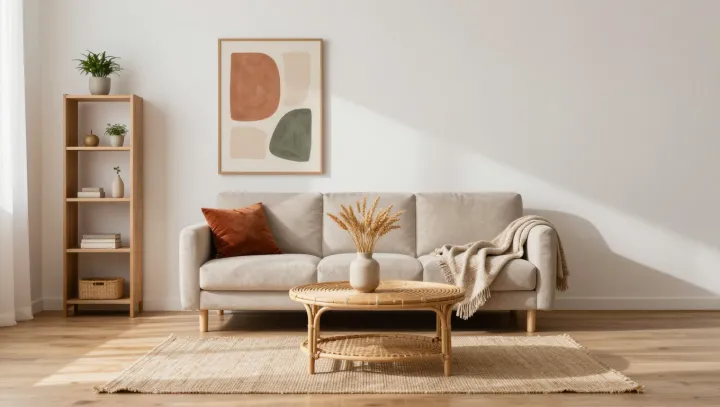
Light does most of the work, not floor plans. A living room wrapped in mid‑tone paint quietly wastes daylight; a large share of incoming illuminance is absorbed rather than bounced. When those same planes shift to pale off‑whites, surface reflectance can jump from roughly thirty or forty percent to well above seventy, sending several times more diffuse light back into the room and deep into corners that previously sat in penumbra.
The room then cheats the eye. With higher reflectance and reduced luminance contrast, boundaries between wall, ceiling and furniture soften, so the visual system loses hard edges that normally signal where space stops. Vision science points to simultaneous contrast and size constancy: when shadows retreat and brightness gradients smooth out, the brain infers greater depth and volume even though no dimension has moved by a single inch. Short distances feel stretched. Dark objects no longer carve the room into fragments.
What sounds like a cosmetic tweak is closer to quiet engineering. By treating every large surface as a secondary light source, the room behaves like a crude light box, amplifying available daylight without extra fixtures or wattage. The result is not only a measurable gain in average illuminance but a disproportionate psychological one, as occupants report the same footprint as almost twice as spacious once the mid‑tones are drained away.